


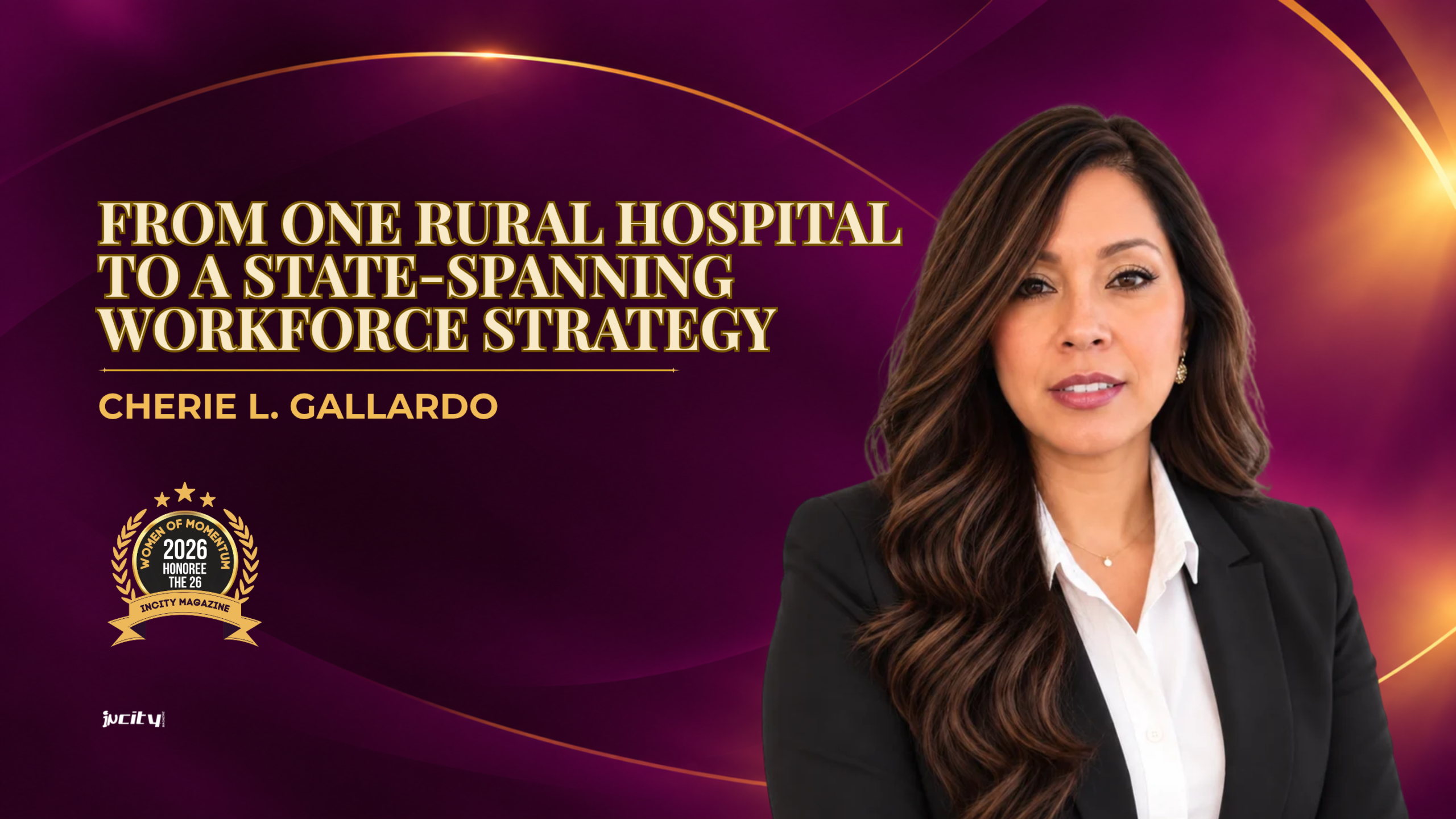
By aligning healthcare employers, colleges, public agencies and $2.42 million in workforce investment, Gallardo helped build a more comprehensive approach to strengthening rural healthcare capacity across Texas.
Women of Momentum 2026 Honoree | By Christopher D. Thomas | Publisher, inCity Magazine
The larger strategy began with one hospital.
During an early conversation with Ward Memorial Hospital, Cherie L. Gallardo and her colleagues encountered a challenge that could not be reduced to a single occupation, certification or training course.
The hospital needed clinical training, but its workforce pressures extended much further. Business services, leadership, compliance and other operational functions were also essential to its ability to serve the community.
That conversation revealed a pattern.
Rural hospitals were not managing one isolated skills gap. They were confronting several workforce challenges simultaneously, often while contending with geographic distance, limited talent pipelines and fewer nearby institutional resources than their urban counterparts.
Instead of forcing those needs into a narrowly defined program, Gallardo helped develop a strategy capable of responding to the institution as a whole.
The result was the $2.42 million Rural Healthcare Initiative, designed to train 1,486 employees across a participant network spanning Texas. Its final roster includes 20 hospital and healthcare entities, along with six WesTex Urgent Care locations in Midland and Odessa.
By September 2026, 678 hospital employees had completed training. The project has been extended through the end of the year.
The numbers establish the initiative’s scale. Its greater significance lies in the infrastructure required to make those numbers possible.
“Sometimes the greatest contribution a leader can make is recognizing what is possible, bringing together people with the right expertise, and creating the conditions for them to accomplish something collectively that none of us could accomplish alone,” Gallardo said.
The Stakes Behind the Strategy
The initiative emerged during a period of persistent workforce pressure throughout healthcare.
At the project’s August announcement, Brent Connett, who represents the public on the Texas Workforce Commission, said healthcare employers can face a gap of up to 50 percent between positions posted and positions filled.
In rural communities, that gap carries consequences extending beyond the labor market.
When a hospital cannot recruit, retain or advance enough qualified employees, the effects can reach patient access, organizational stability and the long-term viability of local care. Distance compounds the challenge. Employees may have fewer nearby education options, and smaller institutions may not possess the internal capacity to design and coordinate large-scale training programs independently.
Gallardo, then serving as Workforce Development Director for the Permian Basin Workforce Development Board, doing business as Workforce Solutions Permian Basin, recognized that funding alone would not resolve those constraints.
The investment needed structure. Employers had to identify their actual needs. Colleges had to translate those needs into accessible instruction. Public agencies had to ensure accountability. Training plans had to remain flexible enough to serve institutions with different workforces, operating environments and priorities.
Gallardo’s role was to help connect those pieces and turn a collection of needs into an executable, state-spanning workforce strategy.
“The greatest impact does not come from having all the resources,” she said. “It comes from recognizing what is possible with the resources you have.”
Impact at a Glance
- Approximately $2.42 million in workforce training investment
- 1,486 employees identified as the project’s training target
- 678 hospital employees trained as of September 2026
- 20 hospital and healthcare entities
- Six WesTex Urgent Care locations in Midland and Odessa
- Seven participating education and training partners
- A geographic footprint extending from far West Texas to Northeast and South Texas
- Project activity extended through December 2026
Designing for the Whole Institution
Many workforce initiatives begin with a predetermined category of training. This project developed differently.
The early conversation with Ward Memorial helped Gallardo and the project team see that inclusion would require more than inviting additional hospitals to participate. It required allowing each institution to define the workforce needs most consequential to its own operations.
The resulting initiative encompasses clinical training, leadership development, revenue-cycle functions, compliance, safety and other operational areas. Training options include simulation-based instruction, de-escalation and courses designed for both direct-care and business-services employees.
This broader design acknowledges a basic operational reality: a hospital depends on an interconnected workforce.
Patient care may be the most visible function, but the institution also relies on employees responsible for billing, compliance, administration, supervision, safety and organizational continuity. Strengthening only one part of that system can leave the underlying workforce problem unresolved.
The initiative provided a maximum allowable investment of $2,000 per employee. That amount was a program ceiling, not an average expenditure or a fixed allocation for every participant.
Hospitals could combine training options according to the needs of different employee groups. Clinical instruction could reach the full allowable amount, while business-services employees might receive a different combination of lower-cost courses. For WesTex Urgent Care, the plan concentrated on a specific capability associated with expanded employee responsibilities and higher wages.
That flexibility allowed the initiative to maintain financial controls while responding to meaningful differences among participating organizations.
Education and Training Partners
The initiative brought together seven colleges to help deliver training across its multi-region footprint in Texas:
- Odessa College
- Angelina College
- Midland College
- Texas State Technical College
- Tyler Junior College
- Western Texas College
- Texarkana College
Their participation helped bridge the distance between rural employers and the education infrastructure required to strengthen their workforces.
The initiative reaches from Big Bend Hospital in far West Texas and Ward Memorial Hospital in Ward County to CHRISTUS Atlanta in Northeast Texas and CHRISTUS Kingsville in South Texas. Its geography makes coordination more complex, but it also demonstrates how workforce systems can connect institutions that share similar challenges despite being separated by hundreds of miles.
The Work Before the Announcement
Large public investments are often introduced through a grant announcement, a ceremonial presentation or a headline figure. The decisive work usually begins much earlier.
Before $2.42 million could become training for healthcare employees, individual organizational needs had to be gathered, evaluated and translated into a plan that employers, colleges and public partners could execute.
That required more than administrative processing.
It required listening closely enough to distinguish an organization’s stated request from its underlying workforce challenge. It required identifying patterns across institutions without assuming that every hospital needed the same solution. It required aligning proposed training with allowable funding while preserving enough flexibility to make the investment useful.
It also required trust.
Employers had to speak candidly about workforce vulnerabilities. Education partners had to assess what they could deliver and where. Public entities had to remain accountable for the use of funds. Someone had to maintain the shared direction across all of them.
Gallardo’s leadership operated within that space between institutional need and coordinated action.
Her work reflects a form of leadership that is not always highly visible but is essential to regional progress: the ability to make complex partnerships functional.
From Program Administration to Strategic Convening
Gallardo’s career spans more than two decades across higher education, grant development, employer initiatives and the public workforce system. Her experience includes work connected to healthcare, energy, manufacturing and the skilled trades.
That background helped her recognize that a workforce board can contribute more than individual services or stand-alone programs.
It can serve as a strategic convener.
Workforce organizations occupy a distinctive position among employers, educators, government agencies and communities. When that position is used intentionally, a board can identify shared needs, align resources and help institutions act at a scale that would be difficult to achieve independently.
The Rural Healthcare Initiative illustrates that expanded role. It did not create a single standardized course and distribute it uniformly. It established a framework through which different institutions could address the workforce needs most relevant to their employees and communities.
Gallardo began developing the initiative while serving as Workforce Development Director. In August 2026, she stepped into her current position as Executive Director of External Affairs and Strategic Partnerships.
The progression is fitting. The work itself demonstrates what strategic partnership looks like in practice: not the accumulation of names around a table, but the construction of an operating structure through which those partners can produce measurable results.
A Model That Can Travel
The initiative remains in progress, and its final impact will be measured not only by participation but by what the training enables institutions and employees to do next.
Yet the strategy already offers a useful model for other regions.
Begin with the needs institutions are actually experiencing. Look for the larger pattern connecting those needs. Give employers room to define their priorities. Connect them with education partners capable of responding. Use public investment with discipline. Build a structure that allows organizations to move together without requiring them to become identical.
That model can apply beyond healthcare.
Communities across the country are navigating workforce shortages, changing technologies, leadership transitions and gaps between available talent and employer demand. The sectors may differ, but the leadership requirement is similar: someone must see the relationships among problems that are often addressed separately.
Gallardo’s contribution was not simply helping secure a large training investment. It was helping transform that investment into workforce infrastructure capable of serving institutions across multiple regions.
That is the movement Women of Momentum exists to document: leadership that does more than attract attention. Leadership that changes what institutions can accomplish together.
“Momentum means recognizing what is possible, bringing together the people, partnerships and resources available to us, and putting them into motion to create meaningful change in our workforce and our communities,” Gallardo said.
For Cherie L. Gallardo, momentum is not defined by visibility.
It is defined by what becomes possible after the right people, resources and institutions have been brought into alignment.

Cherie L. Gallardo
Executive Director of External Affairs and Strategic Partnerships
Permian Basin Workforce Development Board
DBA Workforce Solutions Permian Basin
Odessa, Texas
Recognized for: Leadership beyond visibility through the construction of regional workforce and rural healthcare infrastructure.
Photography courtesy of the Permian Basin Workforce Development Board.
About Women of Momentum
Women of Momentum is an annual editorial initiative documenting women whose leadership creates meaningful commercial, institutional, civic and community movement. The 2026 cohort, The 26, recognizes 26 women whose decisions, work and influence produced measurable impact during the year.
Selection and editorial coverage are independent of sponsorship.
Partnership Opportunities
Organizations interested in supporting Women of Momentum 2026 may review partnership opportunities and request a private conversation.
About the Publisher
Christopher D. Thomas is the founder of Women of Momentum, publisher of inCity Magazine, and founder and president of inMMGroup, a private advisory firm working with leaders whose decisions move people, capital and institutions. His work centers on documenting consequential leadership, strengthening institutional narratives and helping leaders make the significance of their work more visible and understood.
Leave a Reply