


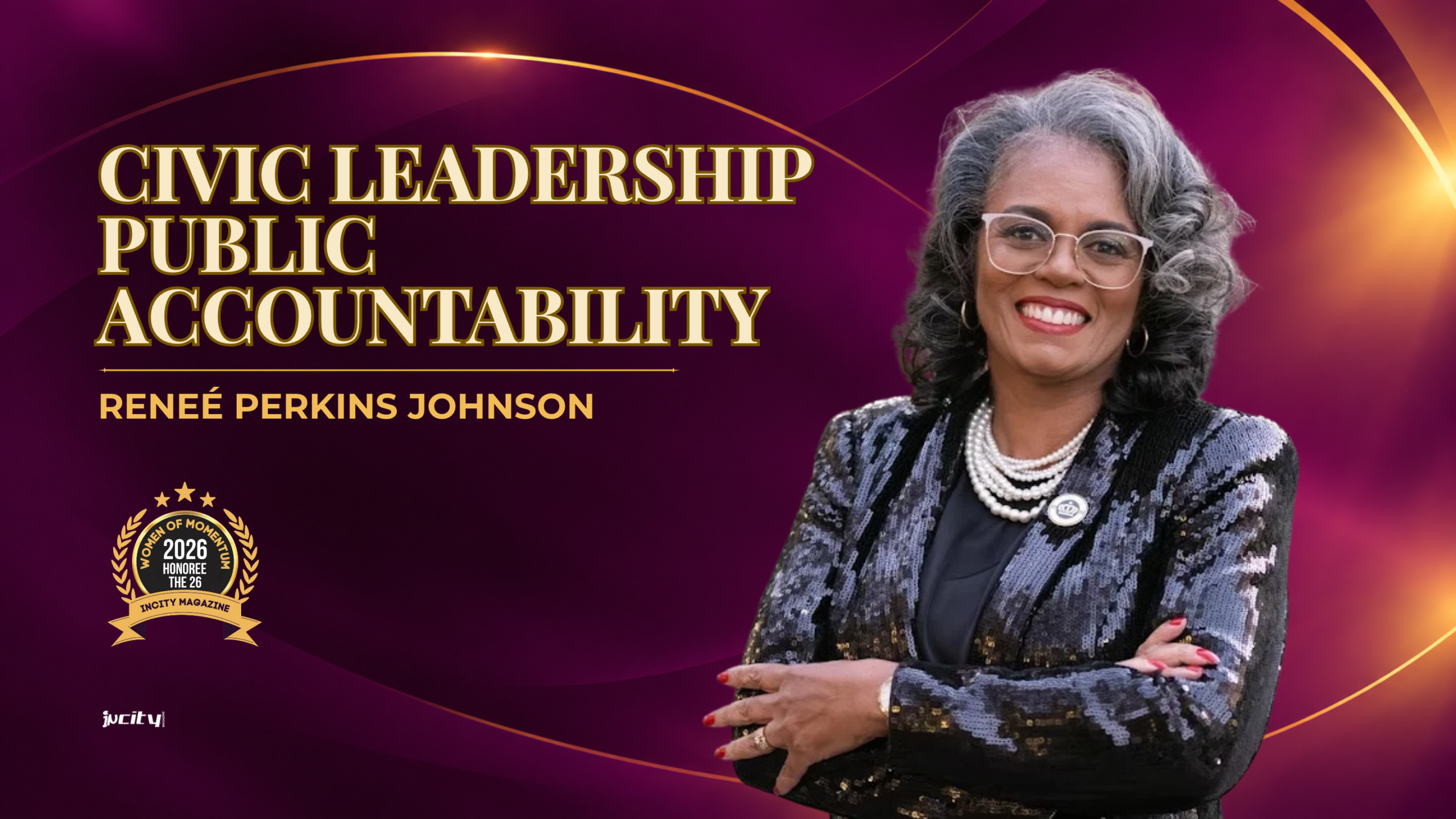
How a Charlotte council member brought resident concerns back into one of the region’s most consequential transportation decisions and remained accountable as the political stakes changed
Women of Momentum 2026 Honoree | By Christopher D. Thomas | Publisher, inCity Magazine
On May 11, 2026, Reneé Perkins Johnson made a motion that changed the course of one of Charlotte’s most consequential transportation debates. The District 4 council member asked the Charlotte City Council to withdraw its support for the proposed public-private partnership to build express toll lanes along I-77 South. The motion passed 6–5. Nine days later, the Charlotte Regional Transportation Planning Organization also rescinded its approval.
Johnson did not dispute that congestion required a serious response. She questioned whether the proposed solution had answered enough of the public’s concerns to move forward responsibly. Residents were raising questions about neighborhood disruption, public cost, parkland, environmental effects and the long-term consequences of delivering a major public asset through a multibillion-dollar public-private financing structure. Johnson believed those questions deserved answers before momentum hardened into inevitability.
The project ultimately regained regional support. Johnson’s 2026 contribution is therefore not defined by control over the final vote. It rests in her willingness to reopen a decision, absorb the pressure that followed and continue representing residents after the political majority moved in another direction.
The 2026 decision at a glance
May 11: Johnson introduced the motion that led Charlotte City Council to withdraw its support in a 6–5 vote.
May 20: The Charlotte Regional Transportation Planning Organization rescinded its regional approval.
July: State legislation created potential repayment exposure estimated at nearly $70 million for Charlotte.
September 21: Charlotte City Council restored its support in a 7–4 vote; Johnson maintained her opposition.
September 23: The regional transportation board reinstated approval.
The resulting agreement established a minimum $300 million Community Benefit Program.
The motion that changed the agenda
The I-77 South corridor carries a real transportation burden. The proposed project would add express lanes along approximately 11 miles between the South Carolina state line and I-277 near Uptown Charlotte. Supporters argued that the public-private partnership offered the only financially viable path to additional capacity, improved travel reliability and long-delayed infrastructure investment.
Johnson’s motion forced a different question into the center of the discussion: viable for whom, under what terms and with what protections for the communities expected to live with the result?
She had listened to residents who believed the process was moving faster than public understanding. Some lived near neighborhoods that had already experienced the dividing effects of earlier highway construction. Others questioned whether the public had current cost information, meaningful alternatives or sufficient influence over the project’s design. By bringing the matter back before the council, Johnson converted those concerns from public commentary into an institutional decision point.
“Advocacy matters. One voice can raise a question, many voices can build momentum, and together those voices can change the outcome.”
The May votes demonstrated that the original political consensus was no longer secure. They were followed by consequences that extended far beyond the council chamber.
When pressure changed the terms
In July, a provision in North Carolina’s appropriations law authorized the state to seek reimbursement of preliminary project costs from local governments involved in removing certain statewide transportation projects. Jurisdictions that had voted to rescind the I-77 authorization could avoid repayment by voting to reinstate it within the statutory period. For Charlotte, the potential exposure was widely estimated at nearly $70 million.
The debate had changed. What began as a disagreement about transportation policy now created substantial financial exposure for local governments. A city could maintain its opposition and risk millions in repayment, or reverse course while attempting to secure better terms for affected communities.
During those weeks, Johnson continued meeting with residents and communicating with community leaders and local and state officials, both privately and publicly. She heard from constituents who said the May vote was the first time they felt represented in the process. Even as the focus shifted toward the financial consequences, she maintained that the public’s original questions had not disappeared.
The Charlotte City Council voted 7–4 on September 21 to restore its support. Johnson remained among the four opposing votes. Two days later, the regional transportation board reinstated approval, allowing the project to move forward.
The revived project did not return under the same public terms. The City of Charlotte and the North Carolina Department of Transportation executed an agreement establishing a minimum $300 million Community Benefit Program financed through the project’s public-private structure. The agreement creates a framework for neighborhood investment, multimodal infrastructure, environmental mitigation, economic mobility and anti-displacement measures, with a more detailed community-benefits plan still to be developed.
The agreement emerged through community pressure, negotiation, changing votes and work across multiple institutions. Johnson’s contribution was earlier and distinct. Her motion helped create the conditions in which the original terms could no longer be treated as sufficient.
From family experience to public advocacy
Johnson’s insistence on listening beyond the most powerful voices did not begin with I-77. It grew from experiences that made systems, vulnerability and survival deeply personal.
Her mother died from a brain injury two decades ago. Other members of her family have sustained brain injuries and survived. Through those experiences and the work that followed, Johnson came to understand how quickly a medical crisis can become a long-term struggle involving care, employment, housing, benefits and the ability to navigate institutions that are difficult even under ordinary circumstances.
She turned that experience into sustained public service. Johnson founded Triumph Services, where she serves as executive director, to support survivors of trauma, including people living with acquired brain injuries. Her broader career includes more than three decades of work involving affordable and re-entry housing, vocational counseling and Medicaid administration. She currently chairs the North Carolina Brain Injury Advisory Council, extending her advocacy into the statewide systems that influence services for survivors and their families.
This background changes the way Johnson sees municipal policy. Brain injury and trauma do not remain confined to a medical chart. They can intersect with homelessness, incarceration, disability, unemployment, veterans’ needs, transportation access and the pressures carried by first responders. To Johnson, these are not separate policy categories. They are overlapping conditions in the lives of people who can easily become invisible when institutions divide responsibility into departments and programs.
That perspective also explains her attention to people who struggle to make themselves heard. Caregiving and advocacy taught her to listen past the loudest participant, examine what a system may be missing and keep the human consequence visible inside an institutional decision.
The responsibility to dissent
Public leadership is often celebrated when it produces a clean victory. Johnson’s 2026 story is more demanding. She initiated a successful reversal, saw the state alter the financial stakes and then watched the local and regional majorities restore the project. Her position did not prevail in the final count.
Elected responsibility is not limited to being on the winning side. It also includes recognizing when the available information is insufficient, when the cost of proceeding has not been fully confronted and when new financial pressure threatens to eclipse the public questions that prompted the original vote. Johnson’s responsibility was to exercise judgment on behalf of the people who elected her, even when that judgment placed her outside the eventual majority.
Her dissent also preserves a public record. If the project advances as planned, residents will be able to measure its implementation against concerns raised before approval and against the benefits promised afterward. That record matters because accountability becomes harder when every objection is absorbed into a claim of consensus.
What remains in motion
The minimum $300 million commitment now requires oversight. The detailed plan must be developed, projects must be selected, financing conditions must be met and promised benefits must reach the neighborhoods for which they were intended.
Johnson has identified that next phase clearly: track the commitments, keep residents informed and test implementation against the language of the agreement. Success will be measured by whether communities experience durable investment, meaningful protection and continued influence as the project moves from approval toward procurement and construction.
Her work also leaves Charlotte with a larger question about the relationship between state power and local judgment. Local officials used an established process to respond to constituents, and state law later attached potential repayment consequences to maintaining that position. Johnson did not resolve that institutional tension, but her stand made it visible.
For Women of Momentum 2026, the movement is not found only in the temporary reversal or the agreement that followed. It is found in what Johnson’s intervention required the process to confront: resident concerns, public cost, community benefit and accountability after approval. Her leadership did not end when her position lost majority support. It moved into the longer responsibility of ensuring that written commitments become visible results for the communities expected to live with the decision.
MOMENTUM MEANS
“Building on every lesson, every challenge, and every person who inspires me, turning pain into purpose and tragedy into triumph.”

Reneé Perkins Johnson
Council Member, District 4
City of Charlotte
Recognized for: Exercising independent judgment under institutional and financial pressure while advancing resident representation and public accountability around one of Charlotte’s most consequential infrastructure decisions.
Photography courtesy of Final Cut Multimedia
About Women of Momentum
Women of Momentum is an annual editorial initiative documenting women whose leadership creates meaningful commercial, institutional, civic and community movement. The 2026 cohort, The 26, recognizes 26 women whose decisions, work and influence produced measurable impact during the year.
Selection and editorial coverage are independent of sponsorship.
Partnership Opportunities
Organizations interested in supporting Women of Momentum 2026 may review partnership opportunities and request a private conversation.
About the Publisher
Christopher D. Thomas is the founder of Women of Momentum, publisher of inCity Magazine, and founder and president of inMMGroup, a private advisory firm working with leaders whose decisions move people, capital and institutions. His work centers on documenting consequential leadership, strengthening institutional narratives and helping leaders make the significance of their work more visible and understood.
Leave a Reply