


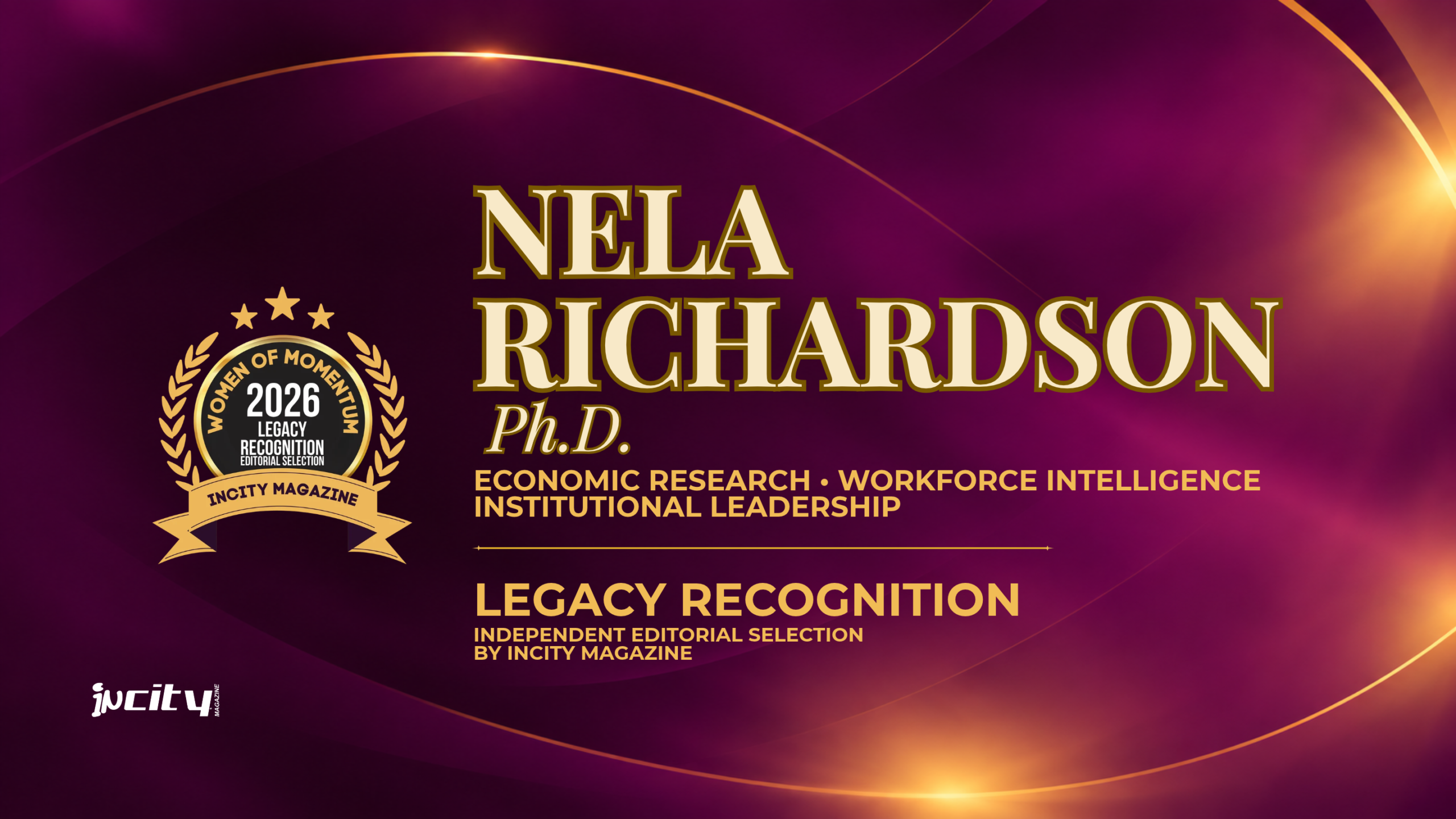
Nela Richardson, Ph.D., has built a career turning economic data into institutional intelligence for businesses, policymakers and workers navigating an increasingly uncertain labor market.
WOMEN OF MOMENTUM 2026 | LEGACY RECOGNITION
INDEPENDENT EDITORIAL SELECTION BY INCITY MAGAZINE
By Christopher D. Thomas | Publisher, inCity Magazine
At a moment when artificial intelligence, demographic change and economic uncertainty are transforming the workplace, interpreting what has already happened is not enough. Leaders need credible ways to see what is changing, where the pressure is emerging and which decisions must follow.
Nela Richardson, Ph.D., has spent her career helping institutions see those changes more clearly.
As chief economist, ESG officer and head of ADP Research, Richardson leads an independent research organization that translates workforce data into intelligence used by business leaders, policymakers and the public. Her influence is not limited to explaining economic conditions. It includes strengthening the infrastructure through which the labor market itself is measured and understood.
That distinction is central to why inCity Magazine has independently selected Richardson for Women of Momentum 2026 Legacy Recognition.
Building a Clearer View of the Workforce
Richardson’s work at ADP operates at an uncommon scale.
In 2021, she led the redesign of the ADP National Employment Report in collaboration with the Stanford Digital Economy Lab. She also led the launch of Pay Insights, which tracks wage growth using payroll information from nearly 10 million workers.
The broader research operation draws upon anonymized payroll records covering more than 25 million employees and a global workforce survey that has reached more than half a million workers. Those resources support research products examining employment, wages, worker sentiment and the changing nature of work.
This is more than economic commentary. It is institutional infrastructure.
By improving the systems through which employment and compensation are examined, Richardson and her team have expanded the evidence available to organizations making decisions about hiring, investment, workforce development and public policy.
A Career Across Economic Institutions
Richardson’s authority rests on a career that crosses government, academia, financial markets, housing and technology.
Before joining ADP, she was a principal and investment strategist at Edward Jones, where she analyzed economic trends and financial-market conditions. She previously served as chief economist at Redfin, leading a team of economists, data scientists and writers studying the housing market.
Her earlier work included serving as a senior economist at Bloomberg and holding research positions at the Commodity Futures Trading Commission, Harvard University’s Joint Center for Housing Studies and Freddie Mac. She also held an adjunct finance professorship at the Johns Hopkins Carey Business School.
Richardson earned a bachelor’s degree from Indiana University with a triple major in mathematics, economics and philosophy. She earned a master’s degree in economics from the University of Pennsylvania and a doctorate in economics from the University of Maryland, College Park, with concentrations in financial economics, international finance and economic development.
The progression matters. Her work has not been shaped from inside a single institution or sector. It reflects an understanding of how economic decisions move through markets, organizations, government systems and individual households.
Authority Built Through Persistence
Richardson’s professional trajectory also reveals what accomplishment can require before it becomes publicly visible.
She has spoken about completing her dissertation after becoming a mother, writing while her newborn slept and entering the employment market already exhausted. Later, while working in government, she discovered that a recently hired male colleague performing similar work was earning approximately $60,000 more. Because the government compensation structure offered no practical way to close the difference, she concluded that leaving was the only viable path to having her value measured differently.
She has also described being mistaken for support staff and being asked to provide directions and coffee before taking her place on an economics panel. In another professional setting, an executive attempted to explain derivatives to her even though her expertise was the reason she was in the room.
Her conclusion was direct: “Smart women should be normalized.”
Those experiences did not become the boundary of her career. Richardson continued moving into positions where she could shape the research, lead the team and influence how institutions interpreted economic change.
Looking Beyond Jobs to the Work Inside Them
Richardson’s relevance in 2026 is especially visible in her work examining artificial intelligence and employment.
At the World Economic Forum in Davos in January, ADP Research and the Stanford Digital Economy Lab launched a research partnership focused on what they describe as the “great job unbundling.” The premise is that conventional employment measures centered on job titles and occupations cannot fully explain how artificial intelligence is changing work.
Jobs are made up of individual tasks. AI may replace, augment or change the value of some tasks without eliminating an entire occupation. The partnership therefore seeks to measure how the value and prevalence of specific responsibilities are changing.
In July 2026, Richardson and Stanford research scientist Andrew Wang published an early analysis built from more than five million job postings linked to payroll data covering more than nine million workers.
Their selected sample of information-technology positions found that design, technical direction and evaluation responsibilities were associated with higher compensation, while several routine maintenance and monitoring functions were associated with lower compensation. The research also identified certain tasks that had declined in value following the widespread introduction of generative AI tools.
The larger contribution is the measurement model itself.
Rather than asking only which jobs will survive artificial intelligence, the research gives employers, workers and policymakers a way to examine which activities within those jobs are becoming more valuable. That creates a stronger foundation for decisions concerning training, career development, organizational design and workforce investment.
Replacing Speculation With Evidence
Richardson’s work also includes the Canaries Dashboard, a collaboration between ADP Research and the Stanford Digital Economy Lab designed to detect early changes in AI-exposed occupations.
The dashboard examines payroll information from millions of workers across more than 730 occupations at tens of thousands of private-sector employers. Its purpose is to identify changes by occupation, age, gender and level of AI exposure before those changes become clearly visible in aggregated employment statistics.
Its September 2026 update found that employment in occupations with high exposure to artificial intelligence had declined 0.6 percent from the previous year. Among workers ages 22 to 25, employment in highly AI-exposed occupations had fallen 4.4 percent, marking 35 consecutive months of year-over-year contraction.
Those findings do not settle the debate over AI and employment. They make the debate more precise.
That is the institutional value of Richardson’s leadership. She has helped move one of the most consequential workforce conversations of this period away from prediction alone and toward observable evidence.
Leadership Beyond Visibility
Richardson has delivered remarks at the World Economic Forum in Davos and the Federal Reserve Bank of Kansas City’s Economic Policy Symposium in Jackson Hole. Her economic analysis has appeared across major financial and news platforms, and her weekly Main Street Macro column connects national and global economic developments to businesses, workers and households.
She also contributes beyond her formal position through service connected to the Stanford Digital Economy Lab, the National Academies Committee on National Statistics, the World Economic Forum Global Futures Council and the U.S. Monetary Policy Forum.
Visibility, however, is not the strongest measure of her leadership.
The stronger measure is what remains useful when the interview concludes, the conference ends or the economic headline changes: research systems, measurement tools, institutional partnerships and clearer evidence for consequential decisions.
A Legacy Still Being Constructed
Legacy is sometimes treated as a retrospective judgment, reserved for work whose most important chapters have already been written.
Richardson’s career offers a different understanding.
Legacy can also be found in the infrastructure a leader creates while the consequences are still unfolding. It is present in the data systems that improve institutional judgment, the partnerships that expand what can be measured and the research questions that change how a field understands its own future.
In 2026, as organizations confront the implications of artificial intelligence, shifting workforce expectations and uneven economic opportunity, Richardson’s work provides something more valuable than certainty. It provides a disciplined way to examine change.
For her sustained contributions to economic research, workforce intelligence and institutional decision-making, inCity Magazine independently selects Nela Richardson, Ph.D., for Women of Momentum 2026 Legacy Recognition.
Her legacy is not simply that she has helped explain the economy.
It is that she has helped build a clearer way to see where work is going next.

About Women of Momentum
Women of Momentum is an annual editorial initiative documenting women whose leadership creates meaningful commercial, institutional, civic and community movement. The 2026 cohort, The 26, recognizes 26 women whose decisions, work and influence produced measurable impact during the year.
Selection and editorial coverage are independent of sponsorship.
Partnership Opportunities
Organizations interested in supporting Women of Momentum 2026 may review partnership opportunities and request a private conversation.
About the Publisher
Christopher D. Thomas is the founder of Women of Momentum, publisher of inCity Magazine, and founder and president of inMMGroup, a private advisory firm working with leaders whose decisions move people, capital and institutions. His work centers on documenting consequential leadership, strengthening institutional narratives and helping leaders make the significance of their work more visible and understood.
Editorial Note
This independent editorial profile was developed from authoritative, publicly available sources. Nela Richardson, Ph.D., ADP and the other institutions referenced did not participate in, review or endorse this article, the selection or the Women of Momentum initiative.
Primary Sources
- ADP Research, “Nela Richardson, Ph.D.”
- World Economic Forum, “Nela Richardson”
- ADP, “Women in STEM Profile: Nela Richardson”
- ADP Research and Stanford Digital Economy Lab, “Unbundling Jobs: Measuring the Value of Tasks in an AI Economy”
- ADP Research and Stanford Digital Economy Lab, “Canaries Dashboard: Employment in AI-Exposed Occupations Slowed in August”
Leave a Reply