


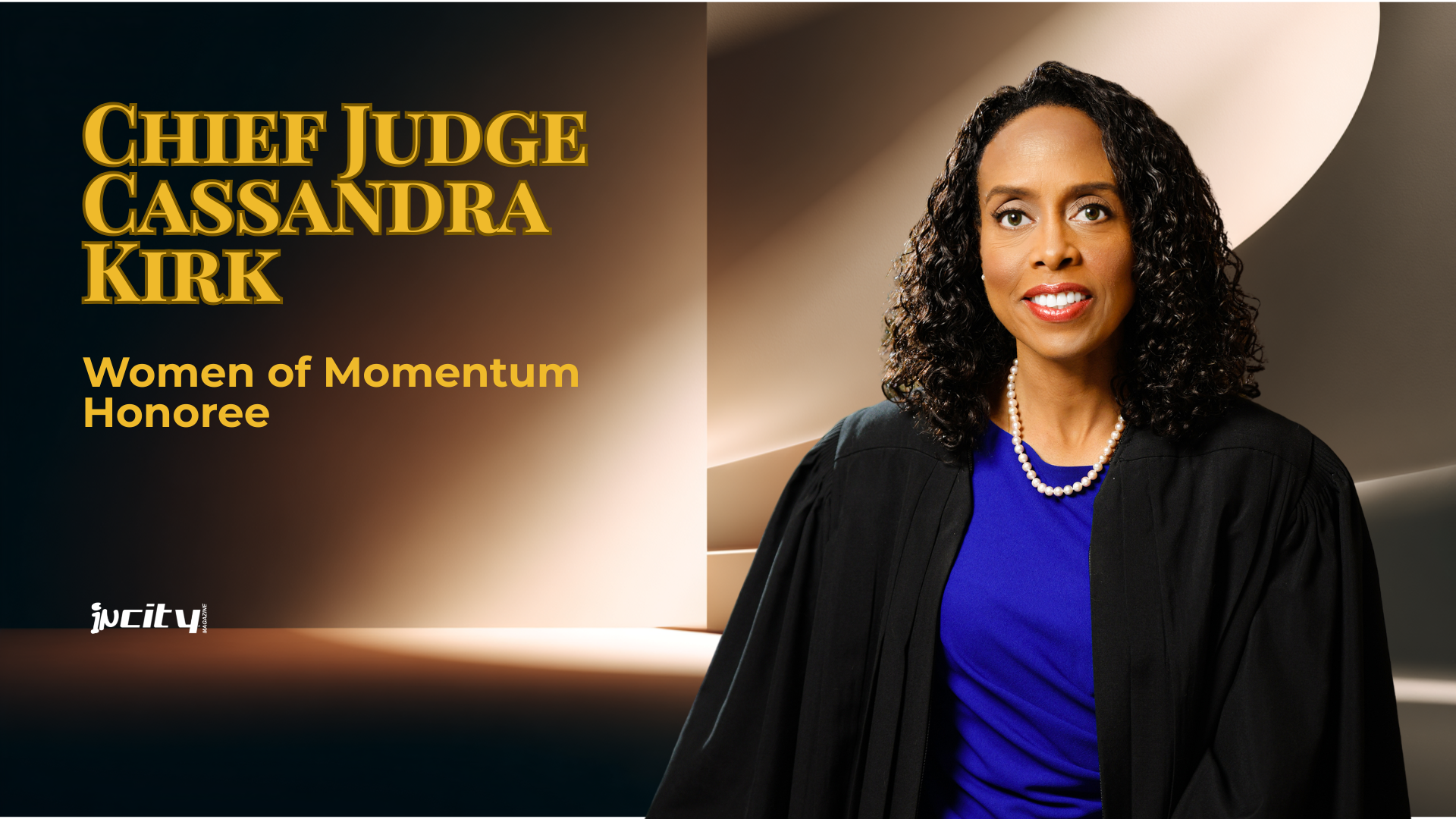
Women of Momentum Honoree • Chief Judge Cassandra Kirk
There are leaders whose work is visible in headlines, and there are leaders whose impact is felt in the daily rhythms of people’s lives. Chief Judge Cassandra Kirk belongs to the latter category – the kind of public servant whose leadership does not seek attention, yet quietly shapes the stability of a community. As Chief Magistrate Judge of the Magistrate Court of Fulton County, she stands at the intersection of law, access, and lived reality, overseeing one of the most human-facing courts in Georgia. Her leadership is not defined by the power of the gavel, but by the trust it represents.
For Judge Kirk, justice has never been an abstract concept. It is procedural, relational, and deeply operational. Every landlord-tenant dispute resolved on time, every warrant processed responsibly, every first appearance conducted with clarity – these are not administrative wins in her view. They are moments where the system either affirms dignity or erodes it. Her leadership has been shaped by that understanding, and in 2025, it became the defining force behind the court’s momentum.
That year, under her direction, the Magistrate Court of Fulton County closed more than 75,000 cases while maintaining a ten-year closure rate above ninety percent – a remarkable feat for one of the county’s least-funded and least-staffed courts. Yet the numbers alone do not capture the story. What mattered most was how the work was done.
Judge Kirk led through a season of structural strain, navigating staffing shortages and funding limitations without allowing the court’s mission to narrow. Instead of relying on urgency or burnout to carry the system forward, she shifted the leadership philosophy itself. The realization that the court could not “work harder” out of systemic pressure became a turning point. Sustainability replaced speed as the guiding principle. Coverage structures were strengthened. Daily triage sharpened. Intern pipelines expanded to stabilize operations across nine courtrooms supported by only three staff members.
In that moment, Judge Kirk’s leadership evolved from resilience to stewardship.
Her philosophy rests on a simple but powerful framework that has guided the court for a decade: Inform, Engage, and Empower the Community. In 2025, that framework moved beyond messaging into visible infrastructure. Programs like Magistrate Court 101 and the R.E.A.C.H. Clinic provided court users with practical understanding of their rights and options. Maggie, the court’s chatbot, became a digital front door offering quick, reliable answers. Bang the Gavel transformed the courtroom into a civic classroom, helping students see justice not as a distant institution but as a system they could understand and trust.
These initiatives were not symbolic outreach. They were strategic interventions designed to reduce confusion, accelerate resolution, and restore confidence in how justice works.
Judge Kirk’s leadership carries an unusual duality: operational discipline paired with deep human awareness. She does not romanticize public service, nor does she separate results from relationships. Her guiding belief is clear:
“We’ve built a court that delivers – day after day – with a team that shows up with excellence and heart. We stay close to the community, we keep innovating even when resources are tight, and we keep outcomes strong. And we don’t do it for applause – we do it because service is the price we pay for our space on earth.”
That perspective reveals the identity architecture beneath her work. She is not trying to build a personal legacy. She is building institutional reliability – a court that works consistently enough that people can trust it without thinking about it.
Her recognitions reflect the breadth of that influence. Appointed by Governor Nathan Deal and twice elected by the citizens of Fulton County, she has also been named among Atlanta Business Journal’s Top Extraordinary Atlantans, honored as a Georgia Legal Trailblazer, Judge of the Year by multiple organizations, and a recipient of the Presidential Lifetime Achievement Award. The court itself has received a Case Clearance Excellence Award with a three-year 254 percent clearance average. Yet Judge Kirk consistently redirects attention back to the team, emphasizing that the court’s effectiveness is collective, not individual.
Looking toward 2026, her leadership is entering a more deliberate phase. She describes her next evolution as choosing capacity over hustle – stronger systems, clearer information, and tools that reduce delays before they begin. The shift is subtle but profound. It signals a leader moving from maintaining excellence to institutionalizing it.
Judge Kirk is also refining what it means to lead with dignity inside a high-volume public system. For her, the future of the court lies in refusing the false choice between efficiency and humanity. The goal is not simply to keep the docket moving. It is to ensure that both court users and court staff experience the system as fair, understandable, and respectful.
This is the trajectory her momentum is carrying forward. Not louder visibility, but deeper reliability. Not expansion for its own sake, but a court increasingly designed to work the way people actually need it to work.
In the end, Chief Judge Cassandra Kirk’s leadership is less about reforming justice and more about stabilizing it – day after day, decision after decision, conversation after conversation. And in a time when institutional trust often feels fragile, that steady presence may be the most powerful form of momentum a community can receive.

inCity Magazine continues to document leaders shaping institutional trust, civic access, and community impact. Organizations, public entities, and leadership teams interested in contributing to future features or institutional conversations may direct editorial inquiries through the inCity Editorial Desk.
Leave a Reply