


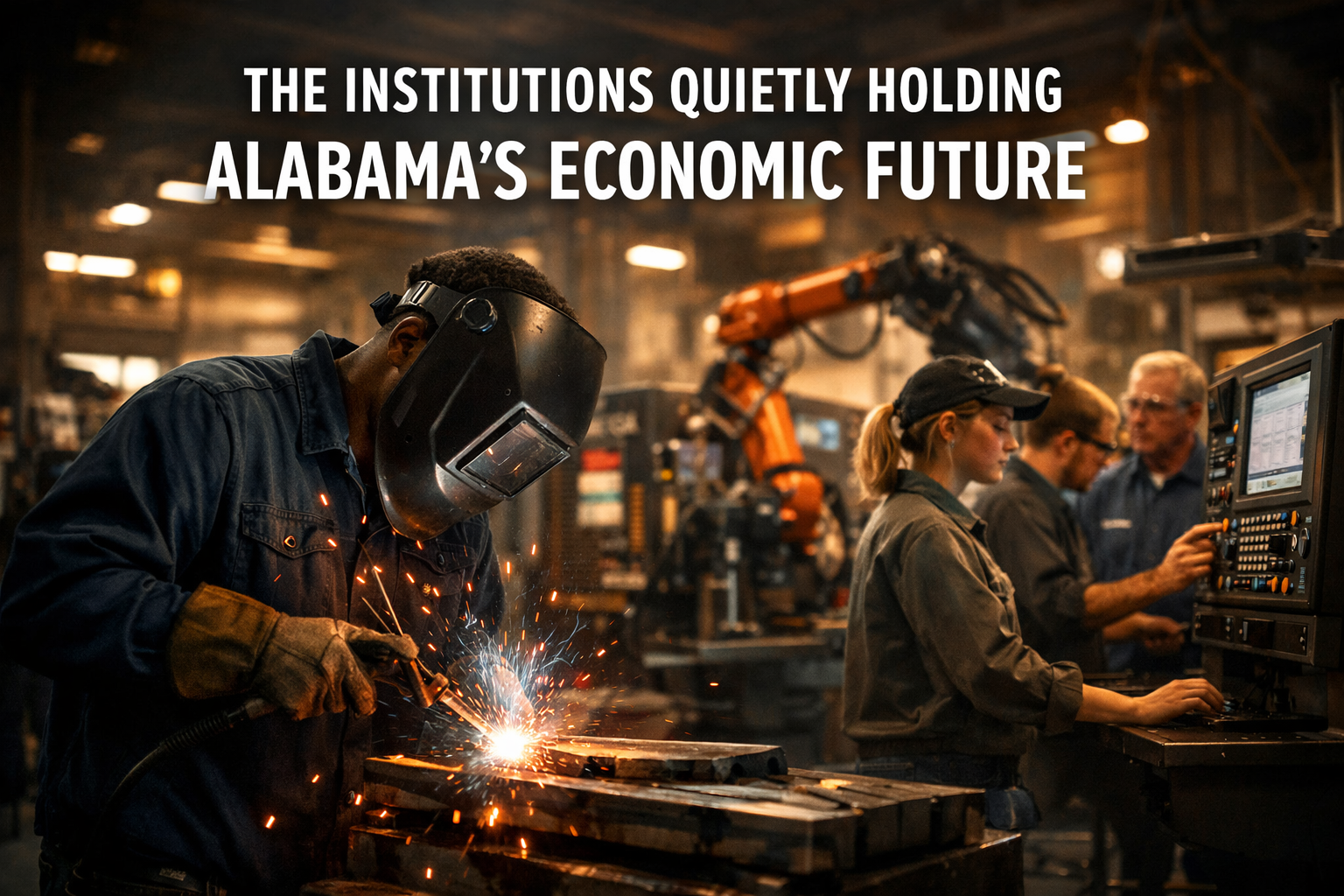
A reflection on the role community colleges are playing in workforce mobility, regional resilience, and economic transformation.
A reflection by Christopher D. Thomas – Founder, inMMGroup | Founder, inCity Magazine
Across Alabama, some of the most consequential work shaping the future of communities is happening in places that rarely dominate national headlines.
In cities and rural counties alike, community colleges are helping individuals rebuild careers, supporting employers struggling to find skilled workers, and quietly stabilizing regional economies.
While universities often occupy the center of the national higher education conversation, community colleges are frequently the institutions closest to the economic realities communities are navigating every day.
They sit at the intersection of workforce demand, economic mobility, and second chances.
And in many regions, they are the institutions quietly holding the future together.
In Alabama, this role is especially visible.
Community colleges serve as entry points for first-generation students, retraining pathways for mid-career workers, and talent pipelines for industries that keep regional economies functioning.
Manufacturing, healthcare, logistics, construction, aviation, and emerging technology sectors all depend on a workforce that is increasingly shaped inside these institutions.
Employers know this.
Regional economic leaders know this.
Students whose lives change through access to new opportunity know this.
Yet the broader story of how these institutions collectively shape Alabama’s economic future is often told in fragments.
Each college carries powerful examples of transformation within its own community.
But the full picture of what these institutions represent for the state’s future rarely appears in one place.
The reality is simple.
Community colleges are no longer peripheral to economic development conversations.
They are central to them.
As workforce demands evolve and industries shift, the institutions that can rapidly prepare skilled talent will increasingly shape whether regions grow or fall behind.
Community colleges have quietly been doing this work for decades.
What has changed is the scale of the responsibility they now carry.
In many communities, the path from classroom to career now runs directly through a community college campus.
If a cabinet meeting were held tomorrow to answer one question – “What institution in our region most directly shapes workforce mobility?” – community colleges would be at the center of that conversation in far more places than we often acknowledge publicly.
This is one reason why the role of these institutions is gaining greater attention from employers, policymakers, and civic leaders across the country.
The work happening inside community colleges is not simply about enrollment or academic programming.
It is about regional resilience.
When industries evolve, communities look for institutions capable of helping workers adapt quickly.
When individuals seek a second chance after economic disruption, they often look to community colleges first.
When employers struggle to find talent prepared for new technologies or changing production environments, partnerships with community colleges frequently become the solution.
These institutions are not simply responding to economic change.
They are shaping how communities navigate it.
Yet even as their impact expands, the story of that impact often travels less clearly than the work itself.
Each institution carries powerful examples of transformation:
A student who becomes the first in their family to enter a high-skill career.
A partnership that allows a regional employer to expand operations.
A training program that stabilizes a workforce pipeline for an entire industry.
These stories exist across the state.
But they often remain local stories.
And the collective story of how community colleges shape the economic trajectory of Alabama is rarely told with the same clarity as the work itself.
Presidents, workforce leaders, and faculty across Alabama’s community colleges are carrying one of the most important responsibilities in the state’s economic future – preparing the workforce that will shape the next generation of industries.
It is a responsibility that rarely appears in headlines but is visible in communities across the state.
Every student who gains new skills.
Every employer who finds the talent needed to grow.
Every family whose economic trajectory changes through education.
These moments accumulate quietly.
But together they form a powerful narrative about what community colleges mean for the future of Alabama.
There is also an opportunity embedded in this moment.
Across the country, states are searching for models that demonstrate how workforce mobility and economic growth can move together.
Many of those answers already exist inside community colleges.
The institutions preparing the next generation of skilled workers, entrepreneurs, healthcare professionals, and technicians are not operating on the margins of economic development.
They are operating at its center.
If the national conversation about workforce development continues to evolve, the institutions shaping those outcomes every day may increasingly define what that conversation looks like.
Community colleges have long been institutions of access, adaptability, and opportunity.
Today they are also institutions of economic stability.
The work happening across Alabama’s community college campuses reflects a broader truth:
When communities face economic uncertainty, the institutions capable of preparing people for the future become some of the most important anchors those communities have.
And in many parts of the country – including here in Alabama – community colleges are already carrying that responsibility.
The question is not whether the impact exists.
That impact is visible in communities across the state.
The question that remains is a different one.
What story about Alabama’s workforce future should the nation hear that only community colleges can tell?
Christopher D. Thomas is the founder of inMMGroup, a private architecture firm that works with leaders and institutions navigating moments of strategic transition. He is also the founder of inCity Magazine, an editorial platform documenting leadership and institutional impact across business, education, and civic life.
Leave a Reply